Disaster Resilience Days 2026: From Research Results to Sustainable Deployment
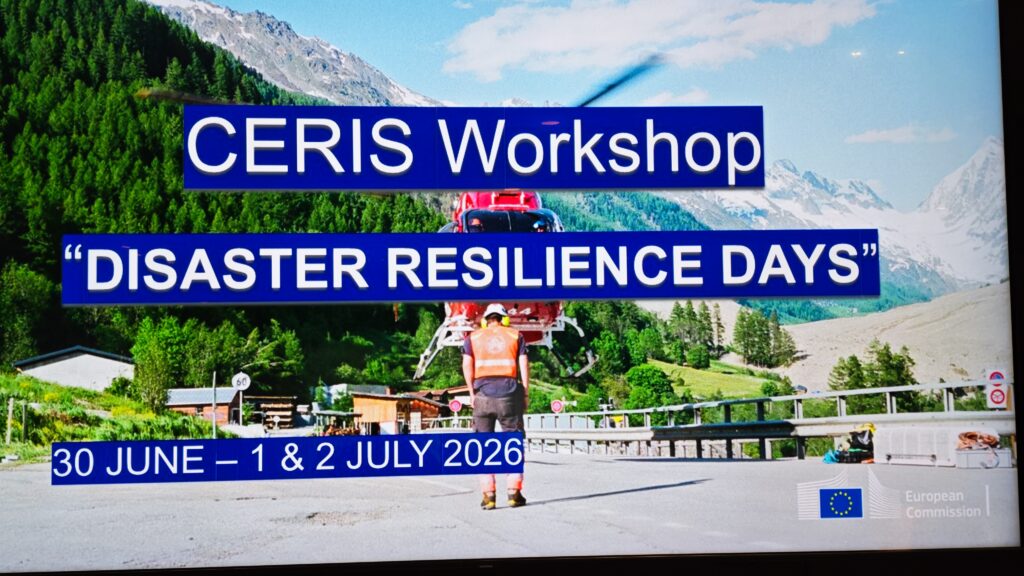
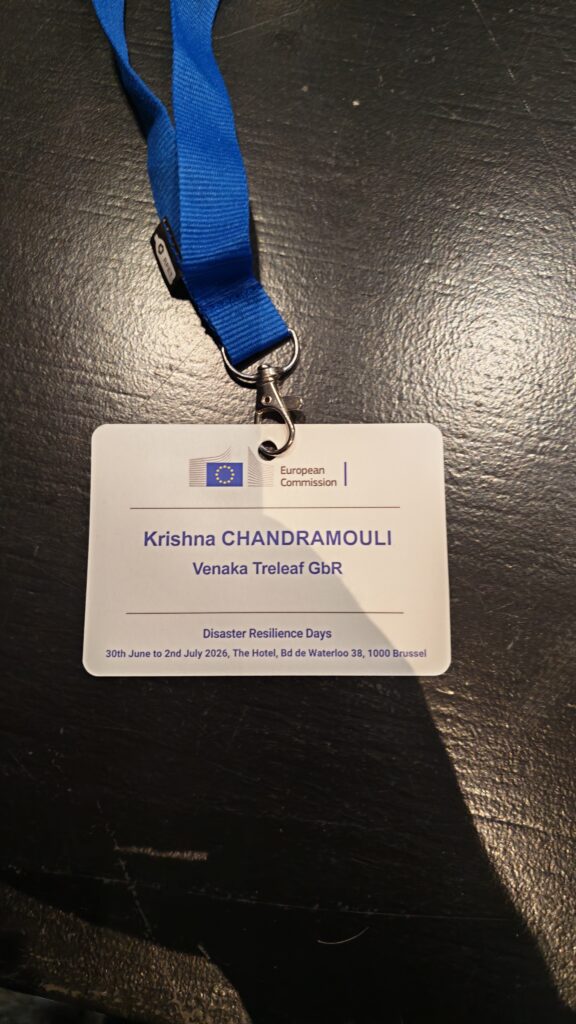
The European Commission’s Community for European Research and Innovation for Security (CERIS) convened its annual Disaster Resilience Days in Brussels from 30 June to 2 July 2026, bringing together researchers, policymakers, first responders, and innovators to address one of Europe’s most operationally urgent questions: how do we move from research results to sustainable deployment in disaster preparedness and crisis response?
Venaka TReLeaf participated across Day 2 and Day 3, presenting and promoting the TERRA project alongside our NexusScholar and NexusAtlas platforms — demonstrating how applied AI and geospatial digital twin technology can bridge the gap between Horizon Europe research outputs and operational deployment for disaster-resilient societies.
Day 2: Command, Control, and Whole-of-Society Preparedness
The second day opened with a keynote from Rachele Beretta of DG ECHO on preparedness by design — a strategic vision for embedding resilience into European infrastructure, governance, and community systems before crises occur, rather than retrofitting it after. This framing set the tone for a day of discussions that repeatedly returned to the same question: how do we make preparedness systematic rather than reactive?
Command and Control: Gaps and Future Needs
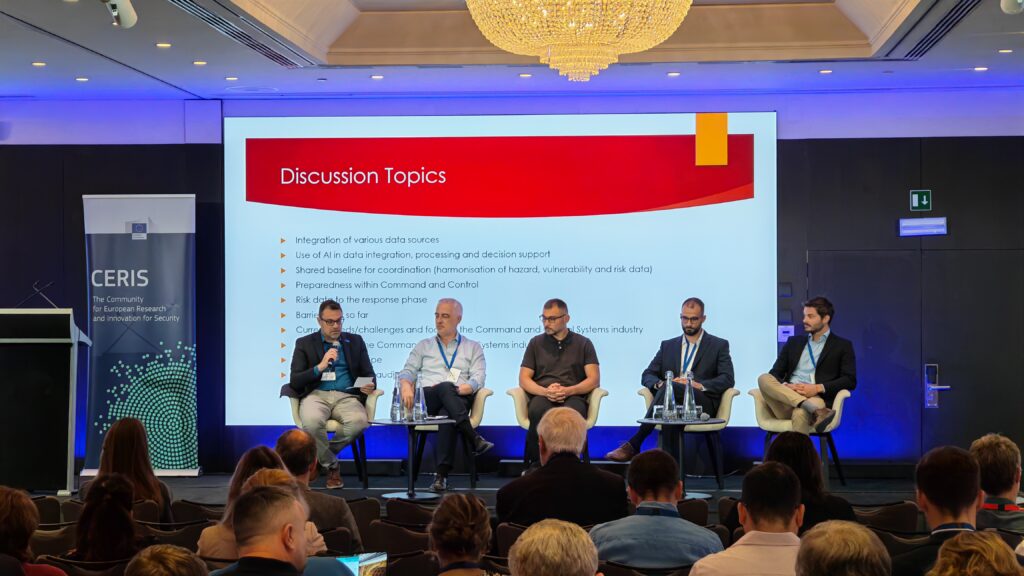
The morning panel on Command and Control Systems in Europe was particularly relevant to our work. The discussion — featuring contributions from ETRA’s POP-ART ISF project, the CARMA project, EURAC’s HURRICANE project, and JRC — surfaced a consistent set of challenges: operational coordination platforms remain fragmented across member states, cross-border command structures lack interoperability, data fusion from heterogeneous sources is technically possible but operationally immature, and secure communications under stress remain an unsolved problem at scale.
What struck us was how directly these gaps align with the capabilities the Nexus suite is designed to address. NexusFlow‘s multi-source data orchestration, NexusAtlas‘s shared operational picture, and NexusScholar‘s ability to interrogate regulatory and procedural documents in real-time are not theoretical solutions — they are deployable capabilities validated in the TERRA project context. The panel reinforced our conviction that the technology exists; the challenge is institutional adoption and cross-border governance.
Whole-of-Society Preparedness
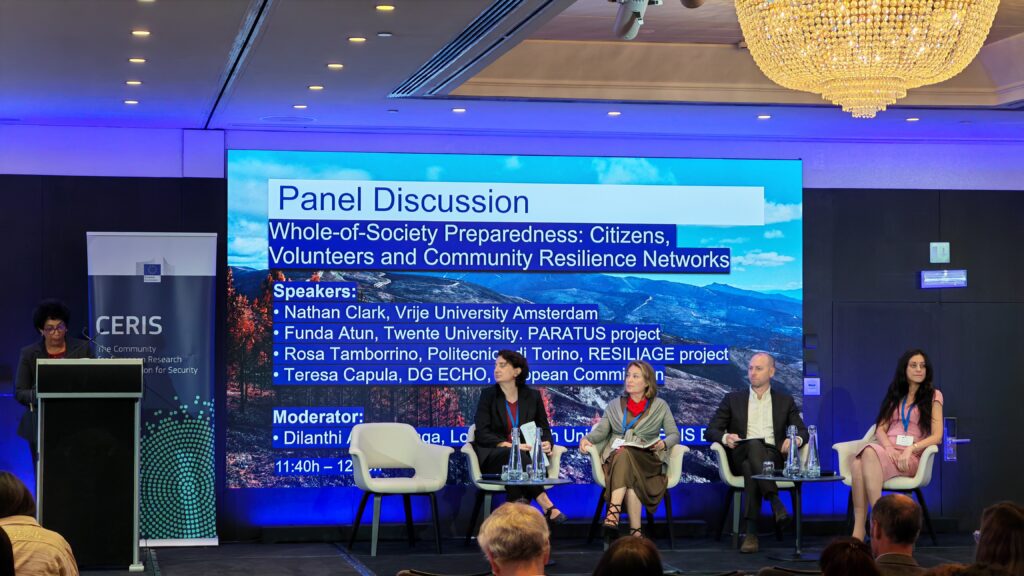
The panel on Citizens, Volunteers and Community Resilience Networks, moderated by Dilanthi Amaratunga from Loughborough University, shifted the focus from institutional systems to the people those systems serve. Contributions from Nathan Clark (VU Amsterdam), Funda Atun (Twente University, PARATUS project), Rosa Tamborrino (Politecnico di Torino, RESILIAGE project), and Teresa Capula from DG ECHO explored how citizen engagement, volunteer mobilisation, and local preparedness ecosystems can be strengthened through participatory crisis response frameworks.
The discussion highlighted a fundamental tension: top-down preparedness systems are necessary for coordination but insufficient for resilience. True resilience emerges from communities that are informed, connected, and capable of self-organising when formal systems are overwhelmed. This resonates with our work on NexusBiome, where citizen-science engagement builds both community connection to the environment and structured data for operational decision-making — the same dual-value model that community resilience networks require.
From Capability Development to Operational Uptake
The afternoon strategic discussion — featuring Isabelle Linde Frich from Fraunhofer, Marcel Van Berlo from TNO, and Tiina Ristmae from THW (SYNERGISE project) — addressed the most persistent problem in disaster resilience R&D: the valley of death between capability development and operational uptake. Projects produce validated prototypes; operational end-users need production-grade systems with training, support, and institutional integration. The gap is not technical — it is organisational, financial, and political.
This is precisely where Venaka positions itself. Our technology roadmap approach (TRL 2–9) is designed to span this valley: we do not stop at demonstrators. We build systems that are deployable, maintainable, and governable — with the documentation, training materials, and operational support that end-users need to adopt technology with confidence. The TERRA project exemplifies this: NexusAtlas and NexusEarth are not research prototypes; they are operational platforms validated in European pilot sites for coastal monitoring, flood risk assessment, and wildfire resilience.
Day 3: Innovation Meets Practice
Matchmaking: Connecting Innovation with Practice
Day 3 opened with a Matchmaking Forum connecting EIC innovators with disaster resilience practitioners — structured networking between technology developers, public authorities, first responders, municipalities, humanitarian actors, and operational end-users. This was where we presented TERRA alongside NexusScholar and NexusAtlas to an audience of potential operational partners and end-users.
The response confirmed what we have observed across multiple engagement contexts: operational end-users are not looking for more AI demos. They are looking for systems that work in their context — that handle their data, integrate with their existing workflows, and produce outputs they can act on within their institutional constraints. NexusScholar’s ability to turn regulatory and procedural document collections into an interrogable knowledge base resonated particularly strongly with practitioners who spend significant time navigating complex, evolving guidance documents during crisis preparation and response.
International Cooperation for Transboundary Crisis Response
The panel on strengthening international cooperation, moderated by Philippe Quevauviller of DG HOME, brought together national contact points from Austria (Jeannette Klonk, FFG), Norway (Ivonne Herrera, Samforsk), and Spain (Marina Martinez, CDTI SOST) to discuss how national research communities can better coordinate for transboundary crisis preparedness. The discussion underscored that disasters do not respect borders, and neither should the research and innovation systems designed to address them.
For Venaka, this reinforces the importance of building products that are interoperable by design — not just technically (APIs, data standards, FHIR, OGC) but institutionally (multi-language support, jurisdiction-aware governance, cross-border data sharing with consent management). The research experience working in external projects such as ESCORT project focused on cross-border healthcare emergencies has taught the need interoperability is 20% technology and 80% governance — and both must be designed together from the start.
European Space Capabilities for Disaster Risk Reduction
The afternoon panel on space capabilities — with representatives from DG ECHO, DG CNECT, and DG DEFIS — explored how satellite services, Earth observation, communications resilience, and predictive intelligence can support disaster resilience actors. This is the operational context for NexusEarth: transforming Copernicus and commercial EO feeds into actionable intelligence for coastal erosion tracking, flood risk assessment, maritime situational awareness, and post-disaster damage mapping.
The panel highlighted both the maturity of European EO capabilities and the persistent gap between data availability and operational use. Satellite data is abundant; what is missing is the downstream processing, AI-driven analytics, and user-facing services that translate raw imagery into decisions. This is exactly the pipeline NexusEarth provides — and hearing the same diagnosis from Commission policy leads validates our product strategy.
Closing Strategic Dialogue: Research to Sustainable Deployment
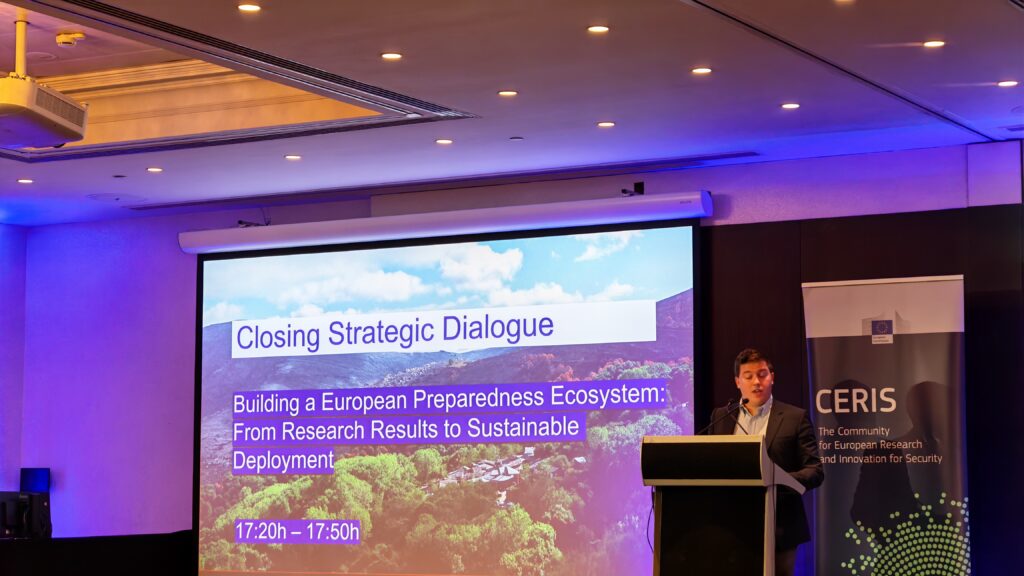
The event closed with a strategic dialogue on building a European preparedness ecosystem that can move from research results to sustainable deployment. The message was clear: Europe has invested significantly in disaster resilience R&D through Horizon 2020 and Horizon Europe. The next phase must focus on sustainability — ensuring that validated technologies are adopted, maintained, and scaled beyond their project lifetimes.
This is the mission Venaka TReLeaf was founded to pursue. Every Nexus product — from NexusAtlas’s geospatial digital twin to NexusScholar’s document intelligence to NexusTrust’s governance assurance — is designed not as a research output but as a sustainable operational capability. Our contribution to the European preparedness ecosystem is not just the technology; it is the engineering discipline, deployment methodology, and lifecycle commitment that makes research results operationally real.
Showcasing TERRA, NexusScholar, and NexusAtlas
Across both days, we had the opportunity to present and promote Venaka TReLeaf’s contributions through the TERRA project (Horizon Europe, GA 101189962) — where VTG leads the AI/ML toolkit Work Package — and to demonstrate how the Nexus product suite translates TERRA’s research outputs into deployable operational capabilities:
- NexusAtlas — our geospatial digital-twin platform, providing multi-layered GIS visualisation, interactive 3D rendering, and decision-support overlays for environmental and climate-resilience operations. Validated in TERRA for coastal monitoring, flood risk, and biodiversity assessment.
- NexusScholar — our document-intelligence platform, enabling natural-language interrogation of regulatory, procedural, and technical document collections with page-level source citations. Demonstrated as a tool for navigating the complex guidance documents that disaster resilience practitioners rely on.
- NexusEarth — our Earth Observation intelligence platform, transforming Copernicus satellite imagery into operational coastal, hydrological, and infrastructure intelligence. The AI/ML engine behind TERRA’s validated pipelines for coastline detection and erosion forecasting.
The engagement from practitioners, policymakers, and fellow researchers was encouraging — and several conversations opened doors to potential collaborations that we look forward to pursuing in the coming months.
Key Takeaways
Three observations from Disaster Resilience Days that will shape our work going forward:
The deployment gap is the central challenge. Europe does not lack disaster resilience research — it lacks the engineering, institutional, and financial infrastructure to turn validated research into sustained operational capability. Every panel, every strategic dialogue, every corridor conversation returned to this theme. For Venaka, this is both a validation and a responsibility: our TRL 2–9 approach exists precisely to bridge this gap, and the demand for it is real.
Interoperability is a governance problem, not just a technical one. Cross-border crisis response requires systems that can share data, coordinate decisions, and maintain accountability across jurisdictions. The technology standards exist (FHIR, OGC, ISO/IEC 23090-8). What is missing is the governance framework — consent management, liability allocation, role-based access across institutions — that makes technical interoperability operationally trustworthy. This is where NexusTrust‘s assurance capabilities and NexusFlow’s auditable orchestration become essential.
Practitioners want systems, not demos. The most consistent feedback from operational end-users was the desire for technology that works in their context — handling their data, fitting their workflows, and producing outputs they can act on under pressure. The era of impressive demos that never deploy is ending. What comes next must be production-grade, maintainable, and governed. This is the standard the Nexus suite is built to meet.
CERIS Disaster Resilience Days — organised by the European Commission, Directorate-General for Migration and Home Affairs, under the Community for European Research and Innovation for Security (CERIS). Held 30 June – 2 July 2026 at The Hotel, Boulevard de Waterloo 38, Brussels, Belgium.
Related: NexusAtlas · NexusScholar · NexusEarth · NexusCare · NexusTrust