
NexusScout
AI-enabled field scouting for early pest detection and integrated pest management.
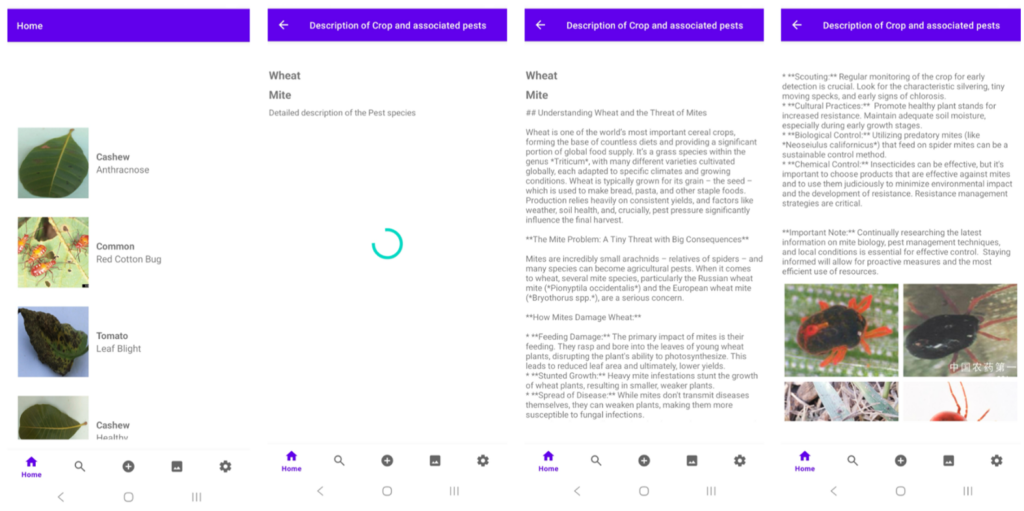
NexusScout is an AI-enabled mobile application that supports early detection and management of crop pests through field-ready scouting tools. It combines image-based pest recognition, geolocation and a structured crop–pest knowledge base to deliver timely, context-aware insights — operationalising the agronomic discipline of field scouting in a digital, climate-adaptive form.
By integrating environmental and climate data, NexusScout enriches understanding of pest dynamics and enables more precise, adaptive decision-making for farmers, advisors and food-chain stakeholders. It connects to NexusFlow for orchestrated agricultural workflows and complements NexusBiome‘s biodiversity monitoring with crop-focused pest intelligence.
Key Features
- On-device and cloud pest recognition — deep-learning classifiers running directly on the smartphone for instant field results, with cloud fallback for complex cases
- Geolocated incident logging — every scouting observation is tagged with precise GPS coordinates, creating a spatial record of pest pressure across fields and seasons
- Structured crop–pest knowledge base — an ontology linking crops, pests, symptoms, life cycles, and management guidance into a queryable intelligence layer
- Environmental and climate data fusion — integrating weather, soil moisture, temperature, and humidity data to model pest dynamics and predict outbreak risk
- Adaptive decision support — recommendations for treatment timing, product selection, and IPM strategies that adjust to local conditions and regulatory constraints
- Reporting and aggregation — dashboards for advisors, cooperatives, and authorities that aggregate field-level observations into regional pest intelligence
Application Areas
Farm & Field
- Smallholder and commercial crop production
- Integrated Pest Management (IPM) programmes
- Climate-adaptive agriculture and early-warning systems
Advisory & Policy
- Agri-cooperatives and farm-advisory services
- Agri-food traceability and One Health surveillance
- Regional pest monitoring and policy support
Technical Specification
| Form Factor | Mobile app (Android-first), with web back-office |
| AI Models | Deep-learning pest classifiers; lightweight on-device inference |
| Data Fusion | Image + geolocation + environmental / climate data |
| Knowledge Base | Structured crop–pest ontology with management guidance |
| Integration | APIs to NexusFlow and farm-management platforms |
| Cluster | Cluster 6 — Farm to Fork |
How It Works
Field Capture
The farmer or scout walks the field and photographs suspect symptoms — damaged leaves, discoloured fruit, visible insects, unusual growth patterns. NexusScout’s mobile interface is designed for field conditions: large capture buttons, offline operation when connectivity is poor, and automatic metadata capture including GPS coordinates, timestamp, crop type, and growth stage. Multiple images can be taken per observation, and the app guides users on framing and focus to maximise recognition accuracy.
AI-Powered Recognition
Captured images are processed by deep-learning pest classifiers — either on-device for instant results or via cloud inference for higher accuracy on complex cases. The models are trained on curated, domain-specific datasets that reflect real field conditions: variable lighting, mixed backgrounds, partial occlusion, and multiple growth stages. NexusScout returns not just a pest identification but a confidence score, differential diagnosis (alternative possibilities), and visual evidence highlighting the features that triggered the classification.
Knowledge-Enriched Context
Every identification is enriched by the crop–pest knowledge base — a structured ontology that links the detected pest to its life cycle, host crops, damage patterns, economic thresholds, and recommended management actions. This transforms a raw image classification into an agronomically meaningful insight: not just “this is aphid X” but “aphid X on wheat at this growth stage typically requires intervention when colony density exceeds Y, and the recommended IPM approach is Z.”
Climate-Aware Intelligence
NexusScout integrates environmental data — temperature, humidity, rainfall, soil moisture, wind patterns — to model pest dynamics over time. Many pests are highly sensitive to microclimatic conditions: a warm, humid period after rainfall can trigger explosive population growth in certain species. By fusing scouting observations with climate data, NexusScout predicts outbreak risk before visible damage occurs, giving farmers a decision-making window that reactive scouting alone cannot provide.
Decision Support & IPM
Based on the pest identification, knowledge base, and environmental context, NexusScout generates adaptive recommendations: whether to treat or wait, which intervention approach aligns with IPM principles, optimal timing based on pest life cycle and weather forecast, and regulatory considerations for the specific crop-pest-region combination. These recommendations are advisory — the farmer makes the decision — but they encode the kind of specialist agronomic reasoning that smallholders and generalist advisors may not have immediate access to.
Aggregation & Regional Intelligence
Individual field observations aggregate into regional pest intelligence through the web back-office. Cooperatives see pest pressure maps across their member farms. Advisory services track emerging threats before they reach individual scout reports. Authorities access aggregated, anonymised data for phytosanitary surveillance and early-warning systems. This bottom-up intelligence model — where thousands of geolocated field observations build a shared situational picture — is the digital equivalent of a national scouting network, but operating in near-real-time.
Why Field Scouting Matters Now
Climate change is redrawing the map of agricultural pest pressure. Species are migrating into new regions, life cycles are shifting, and traditional scouting calendars no longer align with pest emergence patterns. At the same time, the EU Farm to Fork strategy demands a 50% reduction in chemical pesticide use by 2030 — making precise, timely pest management a regulatory necessity, not just an agronomic preference.
NexusScout addresses both pressures simultaneously: by making expert-level pest identification accessible to any farmer with a smartphone, and by embedding climate-adaptive IPM intelligence into the scouting workflow itself. The result is pest management that is more precise, more responsive, and more aligned with sustainability targets — without requiring every farmer to become an entomologist.
Heritage & Lineage
NexusScout builds on VTG’s published deep-learning research for plant-species classification, published in Computers and Electronics in Agriculture (2025). The research demonstrated high-accuracy fine-grained classification of plant species under real field conditions — the same perception capability now adapted for pest identification and deployed as a mobile-first scouting tool within the Nexus suite.
Target Calls: Horizon Europe Cluster 6 (Farm to Fork, Food 2030), Mission A Soil Deal for Europe, and agri-digitalisation calls requiring AI-enabled field intelligence and precision pest management.
Interested in NexusScout?
Contact us to discuss how NexusScout can bring AI-powered pest intelligence to your agricultural operations.
Book a Call →